


CMG Achieves Gender Equality Certification: A Concrete Commitment to the Future
30 June 2026
CMG Granulators at PRS India 2026: Regrind Quality, Compliance 2030, and the EV 92-220 for Plastic Recycling
8 July 2026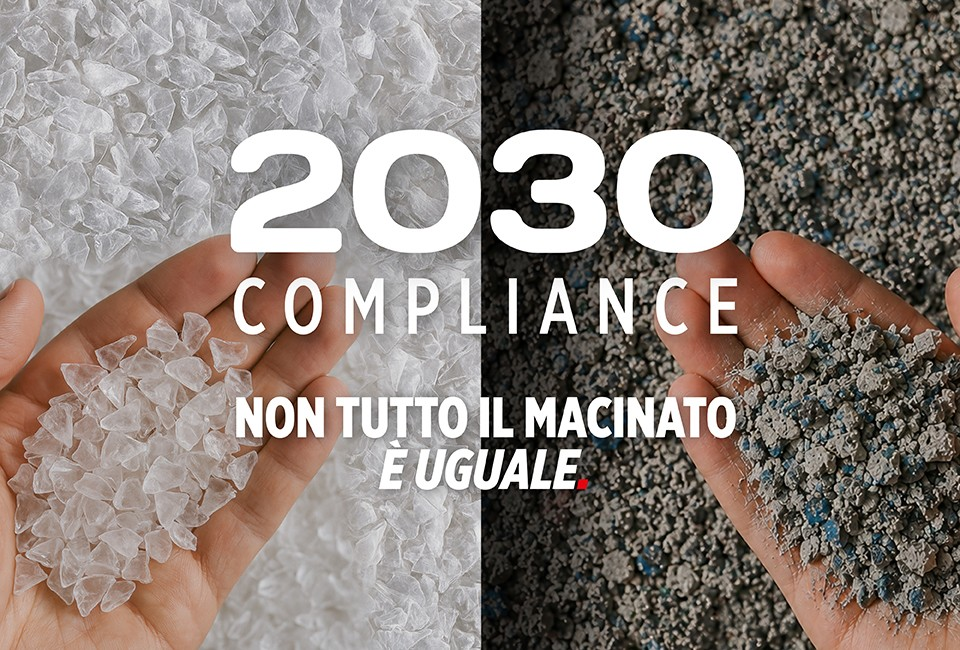
The plastics industry is entering a new phase. The European regulations that will guide the sector toward 2030 are introducing increasingly stringent requirements regarding recycled content, material traceability, process quality, and the performance of finished products.
The new regulatory framework, driven by initiatives such as the Packaging and Packaging Waste Regulation (PPWR), not only sets timelines and minimum recycled content targets for packaging. It also places greater emphasis on key aspects such as design for recycling, packaging recyclability, and the suitability of recycled materials for reuse in manufacturing processes.
In this context, regrind quality is becoming an increasingly strategic factor. Only recycled material with consistent, homogeneous, and controlled characteristics can effectively support regulatory compliance while enhancing a company's competitiveness.
Beyond quantity: the challenge is quality
For many years, the success of recycling was measured primarily by the amount of material recovered. Today, however, the market demands not only quantity but also quality, consistency, and compliance.
To be effectively reused in advanced manufacturing processes, recycled material must meet specific quality standards, including uniform particle size, low dust content, consistent performance, and predictable behavior during subsequent processing stages.
These characteristics directly impact production efficiency, the quality of the finished product, and a company's ability to meet regulatory requirements and customer expectations.
Future regulatory compliance will depend not only on the percentage of recycled material used, but also on its actual quality.
Not all regrind is the same
This awareness inspired CMG's international campaign, "Not All Regrind Is the Same."
A simple message that highlights a reality often underestimated: granulation is not merely a size reduction process—it is a critical operation that directly influences the value of the recovered material.
A high-quality regrind delivers significant advantages:
Less Waste
Greater material uniformity results in lower reject rates and higher production yields.
Improved Processing Conditions
Consistent material properties help reduce downtime, operational issues, and production variability.
Higher Efficiency
The entire processing chain benefits from a more predictable and controllable secondary raw material.
Greater Value of the Final Product
Higher-quality recovered material translates into better product performance and increased economic value.
CMG's answer to the market's new requirements
For more than 45 years, CMG has been developing size reduction technologies for plastics, supporting companies operating in injection molding, extrusion, blow molding, thermoforming, and recycling.
Experience gained through thousands of industrial applications has led to one clear conclusion: regrind quality is one of the key factors in improving the efficiency of the entire production process.
For this reason, CMG technologies are engineered to produce homogeneous regrind with minimal dust generation and consistently stable characteristics over time, helping improve recovered material quality while enhancing downstream process stability.
The Evolution Series, and particularly the EV 92-220 model, represents the most advanced expression of this design philosophy, combining high productivity, reduced energy consumption, and the production of superior-quality regrind.
Compliance and competitiveness: two goals converging
European regulations are accelerating the transition toward an increasingly circular economy.
For plastics manufacturers and recyclers, this means ensuring not only the presence of recycled material in their production processes, but also its quality, traceability, and long-term consistency.
In this evolving landscape, granulation plays a central role.
CMG positions itself as a technology partner capable of turning granulation into a tangible competitive advantage, helping recyclers and plastics processors prepare for the challenges of 2030 through more efficient processes, higher-quality recycled materials, and greater readiness to meet future regulatory requirements.
Because the future of recycling will not depend only on how much material we recover.
It will depend on how well we recover it.
Customer Service
With Headquarters, Production Site and Technical Center in Italy, and the largest distribution network in the plastics industry, CMG is active all over the world with localized technical service, spare parts and sales centers. Find the nearest CMG service center at the following link: https://www.cmg-granulators.com/en/contacts